Knowing when to prune trees can make the difference between a thriving landscape and one that becomes a liability. Many homeowners across the Central Valley wait too long to address overgrown or damaged branches, often turning a manageable situation into a costly emergency. If you are unsure whether your trees need attention this season, these five warning signs will help you decide before the problem gets worse.
1. When to Prune Trees: Dead or Dying Branches Are Appearing
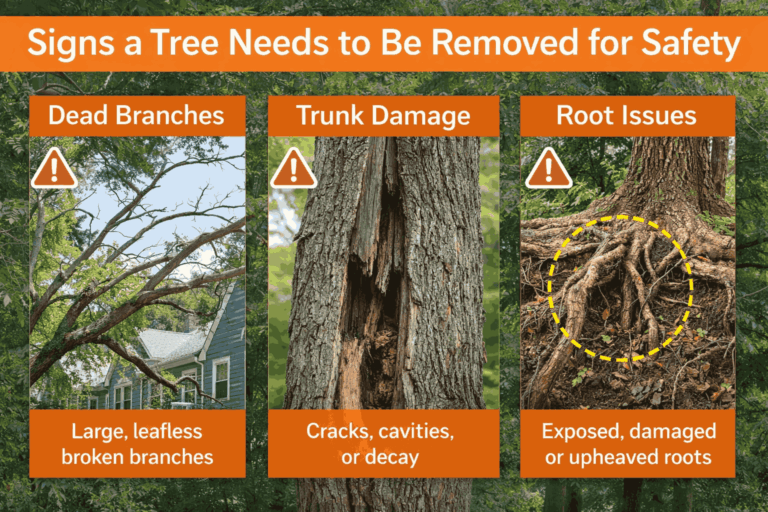
Dead branches are one of the most obvious indicators that your tree needs professional attention. When a branch stops producing leaves during the growing season, loses its bark, or snaps easily under light pressure, it has likely died and will not recover. Dead wood is brittle and unpredictable, meaning it can fall without warning during a windstorm or even on a calm day. In cities like Stockton and Modesto, where residential properties often have large, mature trees close to structures, a falling branch can damage roofs, vehicles, fences, and even injure people nearby.
Dead branches also create entry points for pests and fungal diseases that can spread to healthy parts of the tree. Removing them promptly through proper pruning slows decay and protects the overall structure of the tree. This is not simply about aesthetics — it is about preserving a living asset that can take decades to grow and seconds to destroy if neglected.
2. Branches Are Growing Too Close to Your Home or Power Lines
Branches that hang over your roofline, scrape against your siding, or grow toward utility lines are a serious safety concern. During Central Valley wind events and seasonal storms, overextended limbs put direct pressure on structures and can tear away gutters or puncture roofing material. If branches are within striking distance of power lines, this becomes a public safety issue that needs to be addressed by a licensed professional rather than a DIY weekend project.
Ignacio Gutierrez, co-owner of Jordan’s Tree Service Inc with over 20 years of hands-on tree care experience, emphasizes that proactive clearance pruning saves homeowners significant money over time. When branches are corrected before they contact structures, the cost of pruning is a fraction of what storm damage repairs typically run. Our team holds California Contractor License number 1076959, and every pruning job we perform follows ANSI A300 pruning standards — the industry benchmark for proper tree care practice.
3. The Tree Canopy Has Become Overly Dense or Unbalanced
A healthy tree maintains a canopy that allows light and air to move through it freely. When a tree becomes too dense, the interior branches receive limited sunlight and begin to weaken or die from the inside out. An unbalanced canopy, where one side is significantly heavier than the other, creates structural stress on the trunk and root system. Over time, this imbalance increases the risk of partial or full tree failure, especially during the hot, dry summers common throughout the Central Valley.
Crown thinning and canopy shaping are skilled tasks that require an understanding of how each cut affects the tree’s long-term development. Removing the wrong branch or cutting at the wrong angle can accelerate decline rather than correct it. Claudia Jordan, co-owner and tree care specialist with over 15 years of industry experience, works with clients throughout Lodi, Tracy, and surrounding communities to develop pruning plans that support healthy structure without compromising the natural form of the tree.
4. You Notice Unusual Growth Patterns Like Crossing or Rubbing Branches
Branches that cross each other and rub together create wounds in the bark that expose the tree to infection. As these branches continue to grow, the friction deepens the damage and can girdle a limb, cutting off its vascular flow entirely. This type of structural defect is particularly common in younger trees that have not been pruned during their formative years, but it also develops in mature trees that have simply outgrown their space.
Catching crossing branches early is one of the best investments a property owner can make. A certified pruning professional can identify which branch should be retained based on its angle, attachment strength, and contribution to the overall structure. Correcting this issue while the tree is young requires minimal cuts and causes far less stress than corrective pruning on a mature specimen. For tree pruning in Central Valley CA, property owners in Manteca, Turlock, and Fresno regularly contact Jordan’s Tree Service to handle exactly this kind of early intervention work.
5. When to Prune Trees After Storm Damage or Visible Decay
Storm-damaged trees often look worse than they are, but they can also hide structural problems that are more serious than they appear on the surface. Split branch unions, torn bark, and exposed heartwood all invite disease and insect activity that can accelerate decline rapidly. Visible decay, such as soft or discolored wood, fungal growth at the base of the trunk, or hollow cavities in major limbs, signals that the tree’s integrity may already be compromised.
Understanding when to prune trees in the aftermath of storm damage requires experience and a trained eye. Attempting to remove large, damaged limbs without the proper equipment and knowledge is one of the leading causes of serious injury during DIY tree care. Jordan’s Tree Service Inc offers 24/7 emergency tree service for situations that cannot wait, along with senior discounts for qualifying customers throughout the Central Valley. With more than three decades of combined experience, a valid California contractor’s license, and strict adherence to ANSI A300 pruning standards, our team is equipped to assess, correct, and protect your trees in every season.
Learn more about our Tree Trimming and Pruning Services → https://jordanstreeservice.net/services/trimming-pruning/