How to Tell If a Tree Is Dying or Dead: 7 Warning Signs Every Homeowner Should Know
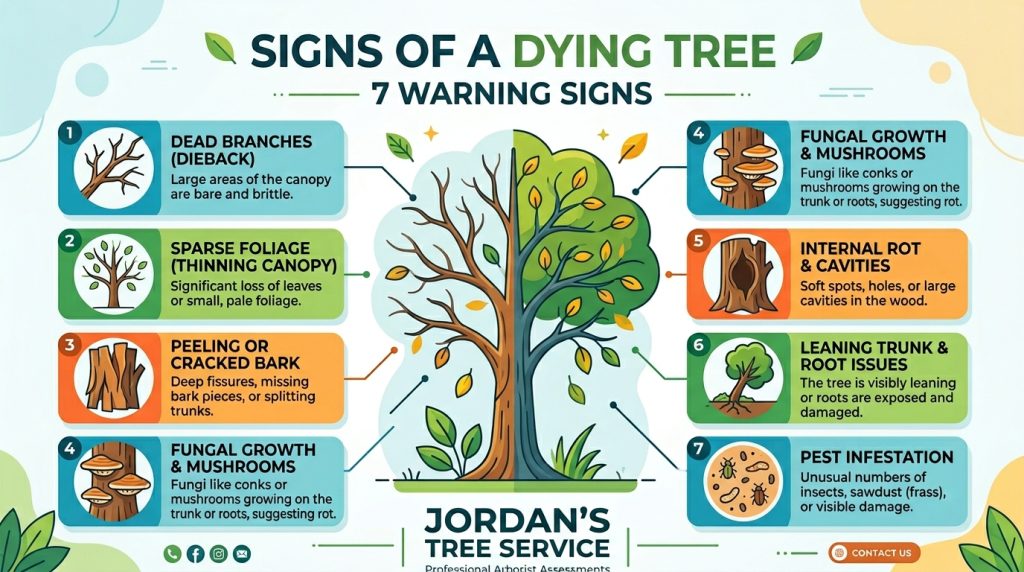
Recognizing the signs of a dying tree early can mean the difference between a simple treatment and a costly emergency removal. Trees decline gradually, and many homeowners in Stockton, Lodi, and across the Central Valley miss the early warning signals until a hazardous situation develops. Understanding what to look for gives you the power to act before a weakened tree threatens your home, your family, or your neighbors. Why Signs of a Dying Tree Are Easy to Miss Trees are remarkably resilient, and that resilience can actually work against homeowners. A tree can look perfectly healthy from the street while silently deteriorating from the inside out. Root disease, internal wood decay, and pest infestations often develop for years before any visible symptoms appear on the canopy. By the time you notice something is clearly wrong, the structural integrity of the tree may already be seriously compromised. This is why routine visual inspections matter so much. You do not need to be an arborist to walk your property and notice changes. You simply need to know what a healthy tree looks like compared to one that is struggling, and you need to take action when something looks off. 7 Warning Signs of a Dying Tree You Should Never Ignore The first sign to watch for is a thinning canopy. When a tree begins dropping leaves earlier than normal, producing fewer leaves each season, or developing large bare patches in the crown, it is signaling that something is wrong at the root level or within the vascular system. This is especially common in the hot, dry summers across the Central Valley, where drought stress accelerates decline. The second sign is dead or brittle branches throughout the upper canopy, not just at the tips. A branch that snaps easily and shows dry, colorless wood underneath is dead. When you see clusters of dead branches rather than isolated ones, the problem is systemic. Third, look for bark abnormalities. Peeling bark, large cracks running vertically along the trunk, or sections where bark has completely fallen away expose the cambium layer underneath. Healthy bark clings tightly to the trunk. Fourth, inspect the base of the tree for fungal growth. Mushrooms or shelf fungi growing at the root flare or along the lower trunk are a strong indicator of internal wood rot. This type of decay hollows out the structural core of a tree and dramatically increases the risk of it falling without warning. Fifth, watch for leaning that appears suddenly. A gradual lean that develops over many years can be natural, but a tree that shifts its angle noticeably after a storm or during the dry season may have compromised roots. Sixth, look closely at the trunk for entry holes made by wood-boring insects. Small round or oval holes surrounded by fine sawdust-like frass are signs of beetles or borers working through the wood. These pests are particularly active in drought-stressed trees throughout Modesto, Manteca, and surrounding communities. Seventh, examine the root zone for heaving soil, exposed roots that look dark and soft, or sections of ground that have lifted around the base. These are signs of root failure that can lead to sudden uprooting. The Scratch Test and Other Simple DIY Checks One of the easiest field tests any homeowner can perform is the scratch test. Use your fingernail or a small pocket knife to lightly scratch the outer bark on a small branch. Beneath the outer layer, healthy wood will show green or white moist tissue. If the wood beneath is brown, dry, and brittle, that section of the tree is dead. Work from the branch tips toward the trunk to determine how far back the die-off extends. Another useful check is the flexibility test on small branches. Bend a branch gently. Living branches flex without snapping. Dead branches crack and break with very little force. Performing these tests in multiple areas of the canopy gives you a more complete picture of the tree’s overall health. Neither test replaces a professional assessment, but both can help you decide whether the situation needs urgent attention. When a Dying Tree Becomes a Dangerous Tree Not every declining tree needs to be removed immediately, but many do. A tree with advanced root rot, a hollow trunk, or major structural cracks poses a real and immediate risk to anything nearby. Wind events, which are common across the dying tree Central Valley CA landscape during storm season, can bring down a compromised tree with very little provocation. The failure rarely happens gradually. It happens all at once. Ignacio Gutierrez, who brings over 20 years of hands-on arboricultural experience to every assessment, evaluates trees using the ANSI A300 standards, the nationally recognized benchmark for professional tree care. These standards guide how a tree’s structure, health, and risk factors are evaluated before any recommendation is made. Jordan’s Tree Service Inc holds California License number 1076959, meaning every removal, pruning job, or emergency response is performed by a fully licensed and insured team that operates to a verifiable professional standard. If you are in Tracy, Fresno, or anywhere in the Central Valley and you suspect a tree on your property is failing, do not wait for visible collapse. The cost of proactive removal is always lower than emergency response and damage repair. What to Do When You Spot the Signs of a Dying Tree Once you have identified one or more warning signs, your next step is to stop treating the situation as a landscaping problem and start treating it as a safety issue. Keep family members and pets away from the area directly beneath the canopy. Document what you are seeing with photos if possible. Note when symptoms first appeared and whether they have progressed quickly. This information helps an experienced arborist assess the timeline and severity of the decline more accurately. Claudia Jordan and Ignacio Gutierrez founded Jordan’s Tree Service Inc on the principle that homeowners deserve honest, expert guidance rather than rushed upsells. When you contact their team,