Tree Removal vs Tree Trimming: Which Service Do You Actually Need?
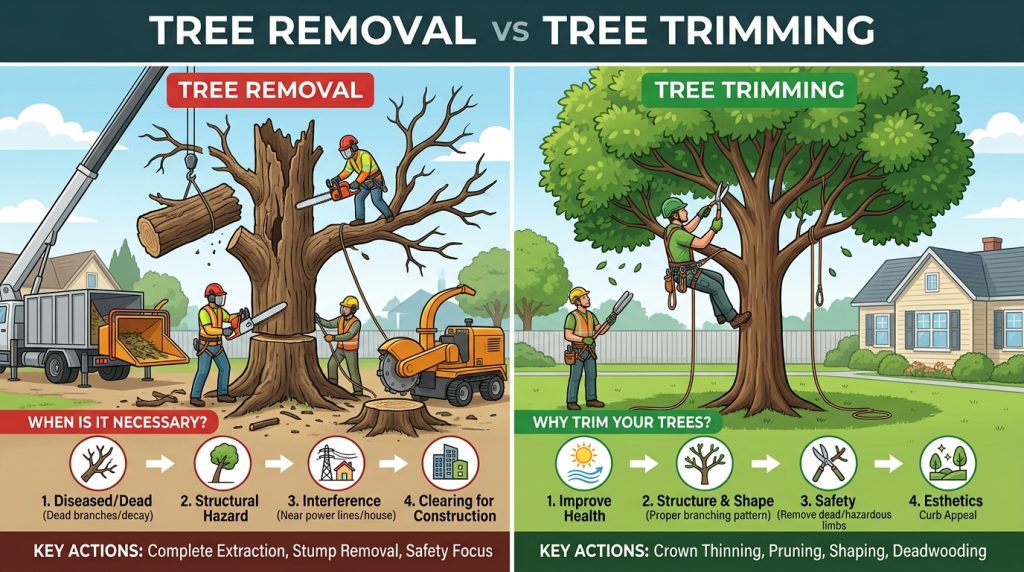
When a tree on your property starts looking unhealthy, overgrown, or just plain dangerous, the question of tree removal vs tree trimming can feel surprisingly difficult to answer. Choosing the wrong service could mean spending more money than necessary — or worse, leaving a genuine hazard standing. At Jordan’s Tree Service Inc, we help homeowners and property managers across the Central Valley make that call with confidence every single day. Understanding What Tree Trimming and Tree Removal Actually Involve Tree trimming and pruning is the selective removal of branches to improve a tree’s health, shape, safety, and overall appearance. When performed correctly — and at Jordan’s Tree Service Inc, that means following ANSI A300 pruning standards, the nationally recognized benchmark for professional arboricultural work — trimming encourages new growth, removes deadwood, and reduces the weight load on aging limbs. It is a targeted, precise service that keeps a living tree doing what it is supposed to do. Tree removal, by contrast, is the complete extraction of a tree from your property, including cutting down the trunk and clearing the debris. It is a more involved process that requires specialized rigging equipment, a thorough understanding of how trees fall, and the kind of situational awareness that only comes from years of hands-on field work. Ignacio Gutierrez, co-owner of Jordan’s Tree Service Inc, brings over 20 years of experience to every removal job the company takes on, and that depth of knowledge directly affects how safely and efficiently each project gets done. Signs Your Tree Needs Trimming Rather Than Removal Not every troubled tree needs to come down. In fact, many trees that look worrying to a homeowner are structurally sound and can be restored with the right pruning approach. You are likely looking at a trimming situation when branches have grown too close to your roofline, power lines, or fence; when the canopy has become so dense that light and airflow are restricted; or when the tree is producing a lot of deadwood but the trunk and major scaffold branches are still solid. Overgrown trees are a common sight in cities like Stockton, Lodi, and Manteca, where residential lots sit close together and mature trees have had decades to spread beyond their original footprint. In these cases, professional pruning does not just make the tree look better — it actively reduces the risk of limb failure during the wind events and heavy rain that sweep through the Central Valley each winter. A well-timed trim can add years, even decades, to a tree’s productive life on your property. Clear Indicators That Tree Removal Is the Right Choice There are situations where trimming is simply not enough, and attempting to preserve a tree past that point creates real danger for people and structures nearby. Removal becomes the responsible choice when a tree is dead or dying with no viable recovery path, when more than fifty percent of the tree has been damaged by disease, storm impact, or pest infestation, or when the root system has begun heaving pavement, invading sewer lines, or undermining a foundation. Structural instability is another decisive factor. If the trunk has developed deep cracks, significant lean toward a structure, or visible decay at the base, no amount of pruning will make that tree safe. The question of when to remove a tree in Central Valley communities like Modesto, Fresno, or Tracy often comes down to proximity — a compromised tree standing twenty feet from an open field is a different risk calculation than the same tree leaning over a garage or child’s play area. Location and structural integrity together determine whether removal is necessary. It is also worth noting that some removals are driven by practical planning rather than emergency. Homeowners clearing land for a new structure, removing a species that creates chronic debris problems, or simply reclaiming yard space may choose removal as a proactive decision rather than a reactive one. How a Licensed Professional Evaluates Your Tree The assessment process is where experience separates a qualified tree service from a crew that simply owns a chainsaw. When Jordan’s Tree Service Inc evaluates a tree, the team examines the crown structure, the quality and density of live foliage, the condition of the bark and cambium layer, any visible signs of fungal growth or pest activity, and the integrity of the root flare at the base of the trunk. These observations, read together, give a trained eye the information needed to make an honest recommendation. Jordan’s Tree Service Inc holds California Contractor License number 1076959, which means the business operates under a regulated framework that protects property owners from unqualified work. Claudia Jordan, co-owner with over 15 years of industry experience, brings a client-first approach to every consultation — making sure homeowners understand exactly what they are paying for and why the recommended service is the right fit for their specific situation. The company also proudly extends senior discounts, because protecting the trees on your property should not be out of reach at any stage of life. Making the Right Call Before the Problem Gets Worse The cost of waiting is almost always higher than the cost of acting. A tree that needs trimming today can become a removal job by next season if the underlying stress is left unaddressed. And a tree that genuinely needs to come down represents a liability every hour it stays standing. When it comes to tree removal vs tree trimming, the right answer is the one that matches the actual condition of your tree — not the cheaper option, and not the more dramatic one. Jordan’s Tree Service Inc serves property owners across the Central Valley with straightforward assessments, transparent pricing, and 24/7 emergency availability for situations that simply cannot wait. If you have a tree that is giving you pause in Stockton, Turlock, or anywhere in between, the right move is to get a professional set of eyes on it before the decision gets made for you by a storm. Learn